

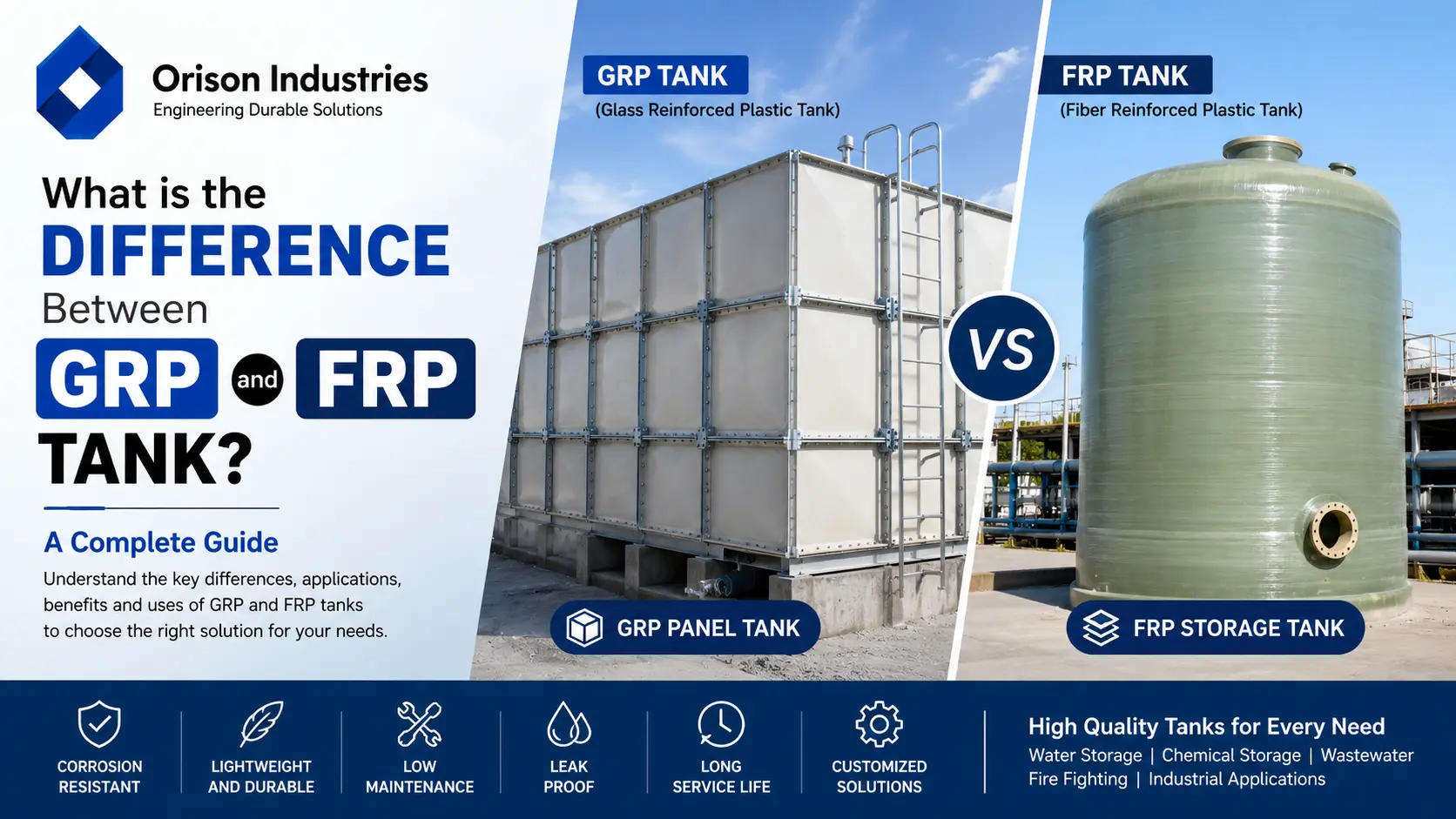
Water storage tanks and liquid handling solutions are vital to the operation of industries, companies, and municipalities. There are numerous types of water storage tanks that you can opt for, with the most popular being GRP and FRP tanks. Unfortunately, many customers and professionals find it hard to differentiate between GRP and FRP tanks. This article seeks to help you know the main difference between the two types of tanks and how to make the right choice based on your needs. This blog post will shed light on the difference between GRP and FRP tanks and where they can be applied.
Understanding GRP and FRP
Before comparing the two, it is important to understand the terminology.
The GRP tank full form is Glass Reinforced Plastic Tank. These types of tanks are produced by the combination of plastic with fine glass fiber. GRP tanks find extensive use in storing water, and they are commonly available in modular panels.
The FRP tank full form is Fiber Reinforced Plastic Tank. FRP refers to a wider range of materials using different kinds of reinforcement materials such as glass fibers. In other words, GRP can be classified as FRP.
While both tanks share similar properties, their design, construction methods, and applications can differ significantly.
Also Read: Complete Guide to Fire Water Tank Design, Capacity and NBC Compliance in India
What is a GRP Tank?
A GRP water tank is typically made using modular panels that are assembled at the installation site. These tanks are widely used for storing potable water, firefighting water, process water, and other liquids.
Many industrial projects prefer GRP tanks because they can be customized according to capacity requirements and installed even in locations where transporting large tanks is difficult.
The term grp panel full form refers to Glass Reinforced Plastic Panel, which is the basic building block used to construct a GRP panel tank. Individual panels are connected together to create tanks of different sizes and capacities.
Features of GRP Tanks
- Lightweight construction
- Excellent corrosion resistance
- Modular design
- Easy transportation and installation
- Suitable for potable water storage
- Long service life
- Low maintenance requirements
Because of their modular construction, GRP tanks are often selected for commercial buildings, industrial facilities, hospitals, educational institutions, and municipal water storage projects.
What is an FRP Tank?
An FRP water tank is manufactured using fiber-reinforced plastic materials and is generally produced as a single molded unit or customized fabricated structure. FRP tanks are widely used across various industries due to their high strength and chemical resistance.
Unlike GRP tanks, FRP tanks are available in different shapes, including cylindrical, vertical, horizontal, and rectangular designs.
An FRP storage tank is commonly used for storing water, chemicals, industrial liquids, and wastewater. Due to its superior resistance to corrosion and chemicals, FRP is often preferred in harsh industrial environments.
Features of FRP Tanks
- High strength-to-weight ratio
- Excellent chemical resistance
- Corrosion-resistant structure
- Long operational life
- Easy maintenance
- Customizable designs
- Suitable for industrial applications
Industries such as chemical processing, pharmaceuticals, water treatment, food processing, and manufacturing frequently use tank FRP solutions for liquid storage requirements.
Key Differences Between GRP and FRP Tanks
1. Material Composition
The primary difference lies in the reinforcement material.
GRP Tanks only use glass fiber as the reinforcing material, while FRP tanks may employ various forms of reinforcing materials, which may be glass fiber among others.
Therefore, all GRP tanks can be referred to as FRP tanks, but not all FRP tanks will be GRP tanks.
2. Design and Construction
A GRP panel tank is generally assembled from multiple prefabricated panels. This modular construction allows easy transportation and installation. In contrast, an FRP storage tank is often manufactured as a single molded structure or custom-fabricated vessel depending on the application.
3. Installation Flexibility
GRP tanks offer excellent flexibility for large-capacity installations because they can be assembled on-site. FRP tanks are usually delivered as complete units, making them ideal for smaller to medium-sized applications where transportation is not a challenge.
4. Application Areas
A GRP water tank is primarily used for water storage applications such as:
- Drinking water storage
- Firefighting water storage
- Rainwater harvesting
- Municipal water supply
An FRP water tank can handle a broader range of applications including:
- Industrial water storage
- Chemical storage
- Wastewater treatment
- Process liquid storage
5. Chemical Resistance
FRP tanks generally offer better customization for chemical resistance requirements. An FRP chemical tank can be designed specifically to store acids, alkalis, solvents, and other corrosive liquids. This makes FRP a preferred choice for chemical industries.
Applications of GRP Tanks
GRP tanks are widely used in:
- Residential complexes
- Commercial buildings
- Hospitals
- Hotels
- Educational institutions
- Fire protection systems
- Water treatment plants
- Municipal water storage projects
The modular structure of a GRP panel tank makes it ideal for projects requiring large storage capacities and site-specific configurations.
Applications of FRP Tanks
FRP tanks are commonly used in:
- Chemical industries
- Pharmaceutical plants
- Food processing facilities
- Effluent treatment plants
- Sewage treatment plants
- Manufacturing industries
- Power plants
- Water treatment facilities
Many industries also utilize an FRP septic tank because of its corrosion resistance, lightweight structure, and long service life.
Which Tank is Better for Water Storage?
When selecting a water tank FRP or GRP tank, the answer depends on the application.
If the requirement involves large-scale potable water storage with modular installation advantages, a GRP water tank is often the preferred solution.
However, if the application involves aggressive chemicals, industrial liquids, or specialized process requirements, an FRP water tank or FRP chemical tank may provide better performance.
Both options offer excellent durability, corrosion resistance, and long-term reliability when properly designed and maintained.
Factors to Consider Before Choosing
When selecting between GRP and FRP tanks, consider the following:
Storage Purpose
Determine whether the tank will be used for water, chemicals, wastewater, or industrial liquids.
Capacity Requirements
Large-capacity projects often benefit from modular GRP panel systems.
Installation Location
Site accessibility may influence whether a panel tank or molded tank is more suitable.
Chemical Exposure
For aggressive chemicals, customized FRP tanks may be the better option.
Maintenance Requirements
Both GRP and FRP tanks require minimal maintenance compared to conventional steel or concrete tanks.
Importance of Choosing Reliable Manufacturers
The performance of any storage tank largely depends on manufacturing quality and design standards. Working with experienced manufacturers ensures better material quality, structural integrity, and long-term performance.
Trusted FRP tank suppliers can provide customized solutions based on specific industrial requirements, while professional GRP tank manufacturers can design modular storage systems for large-scale water storage projects.
Conclusion
Understanding the difference between GRP and FRP tanks is essential when planning a water or liquid storage project. The GRP tank full form is Glass Reinforced Plastic Tank, while the FRP tank full form is Fiber Reinforced Plastic Tank. Although both offer excellent strength, corrosion resistance, and durability, their construction methods and applications vary.
A GRP panel tank is ideal for modular water storage applications, while an FRP storage tank is often preferred for industrial and chemical storage needs. Whether you require a GRP water tank, FRP water tank, FRP chemical tank, or FRP septic tank, choosing the right solution can significantly improve operational efficiency and long-term performance.
At Orison Industries, high-quality zincalume water storage tank solutions are designed to meet diverse industrial and commercial requirements, ensuring reliability, durability, and maximum value for every project.
Pingback: Welded vs Bolted Tanks: Which Storage Tank is Better for Your Industry?