
Storage facilities should always be efficient if one is to maintain high quality standards while reducing waste and enhancing agricultural activities. Silos are some of the best ways of storing grains, seeds, feed, and other commodities, although there are several other types of storage facilities used by different people. One of the biggest concerns when purchasing a silo is whether to go for a hopper bottom silo or a flat bottom silo.
While the two facilities have their own functions, their differences can actually be many, ranging from capacity and design through the method of loading to areas of application.
In this guide, we will compare hopper bottom silos and flat bottom silos, discuss the importance of silo shape, and explain which option may be best for your storage requirements.
What Are Flat Bottom Silos?
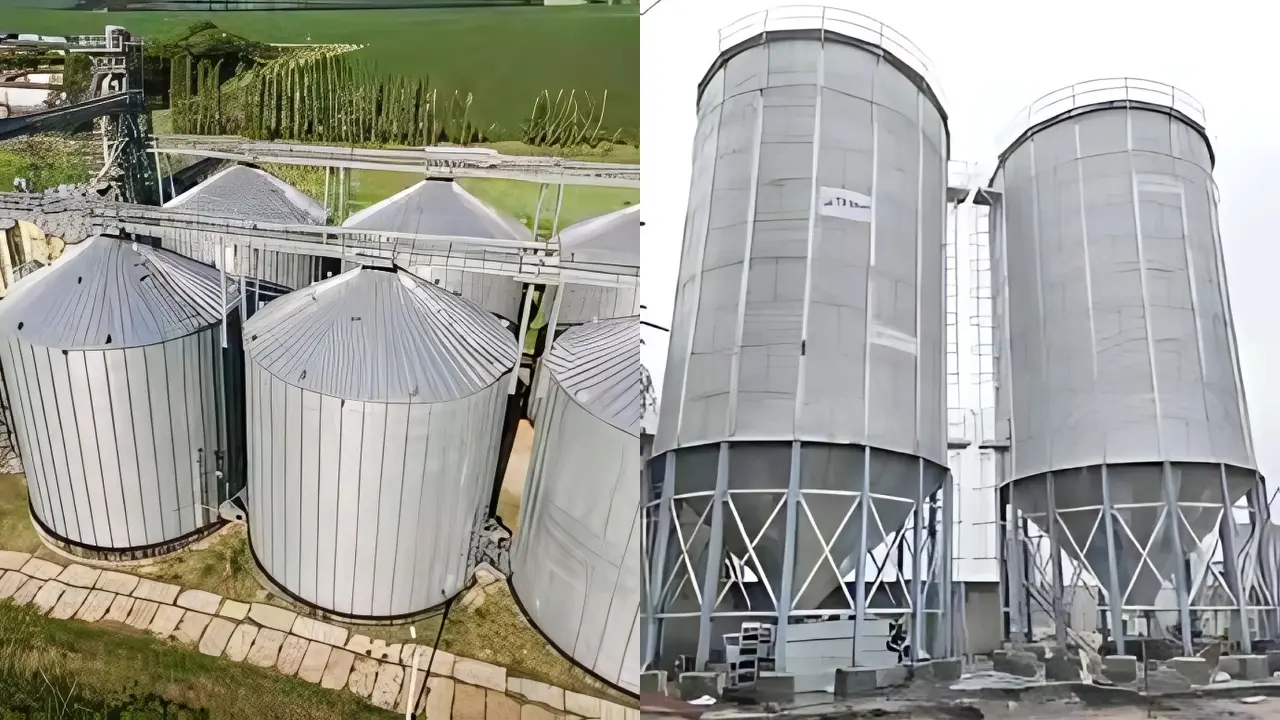
Flat bottom silos are cylindrical storage structures with a flat base. These silos are commonly used for long-term storage of large quantities of grain and other bulk materials.
The flat base rests directly on a reinforced concrete foundation. Material is typically unloaded using sweep augers and discharge systems installed at the bottom of the silo.
Because of their large storage capacity, flat bottom silos are widely used in grain terminals, large farms, rice mills, feed plants, and commercial storage facilities.
Key Features of Flat Bottom Silos
- Large storage capacities
- Cost-effective for bulk grain storage
- Suitable for long-term storage
- Durable galvanized steel construction
- Efficient aeration systems
- Lower cost per ton of stored grain
When people ask “what shape is a silo?”, the answer depends on the design and application. Most modern silos are cylindrical structures because this silo shape provides excellent strength, efficient load distribution, and maximum storage capacity. However, the bottom section of the silo can vary, leading to two major categories: flat bottom silos and hopper bottom silos.
What Are Hopper Bottom Silos?
Hopper bottom silos feature a cone-shaped base that allows materials to flow downward naturally through gravity. The bottom section resembles a funnel, enabling quick and efficient unloading.
These silos are especially useful when frequent loading and unloading operations are required. In many cases, a hopper bottom silo functions similarly to a conical grain storage tank, where the sloped bottom facilitates complete discharge without requiring additional sweeping equipment.
Because of their self-cleaning capabilities and ease of unloading, hopper bottom silos are often preferred for seed storage, feed storage, and short-term grain handling operations.
Key Features of Hopper Bottom Silos
- Cone-shaped bottom design
- Gravity-assisted unloading
- Faster material discharge
- Reduced grain residue
- Lower maintenance requirements
- Suitable for frequent inventory turnover
Understanding the Importance of Silo Shape
The silo shape plays a significant role in determining storage efficiency, structural stability, and unloading performance.
The cylindrical body of a silo distributes grain pressure evenly, making it one of the strongest storage designs available. The main difference lies in the bottom configuration.
A flat bottom design maximizes storage volume and is ideal for long-term storage, while a cone-shaped bottom improves discharge efficiency and reduces leftover material.
For applications requiring rapid unloading, a conical grain storage tank or hopper bottom silo is often the preferred choice.
Hopper Bottom Silo vs Flat Bottom Silo: Major Differences
1. Bottom Design
The most obvious difference is the bottom structure.
Flat Bottom Silos
- Flat concrete-supported base
- Require sweep augers for complete unloading
Hopper Bottom Silos
- Cone-shaped steel hopper
- Allow gravity-based discharge
2. Storage Capacity
Flat bottom silos generally offer much larger storage capacities than hopper bottom models.
Large commercial grain storage facilities often choose flat bottom silos because they can store thousands of tons of grain economically.
Hopper bottom silos typically have smaller capacities but provide greater operational flexibility.
3. Unloading Efficiency
One of the biggest advantages of hopper bottom silos is their ability to unload grain quickly and efficiently.
Gravity helps move material toward the outlet, reducing manual intervention and minimizing grain residue.
Flat bottom silos often require mechanical sweep systems to remove remaining grain after unloading.
4. Installation Cost
Flat bottom silos generally have a lower cost per ton of storage capacity.
However, hopper bottom silos may require additional structural support because the cone-shaped bottom must withstand the weight of stored material.
For smaller capacities, hopper bottom silos can still be a cost-effective option.
5. Maintenance Requirements
Flat bottom silos require maintenance of sweep augers, discharge systems, and cleaning equipment.
By contrast, hopper bottom silos have fewer moving components involved in unloading, reducing maintenance requirements.
6. Grain Quality Management
Both systems can be equipped with aeration, temperature monitoring, and ventilation systems.
However, hopper bottom silos often reduce grain residue buildup, lowering the risk of contamination between storage cycles.
Advantages of Flat Bottom Silos
- Maximum Storage Capacity- Flat bottom silos are ideal for facilities that need to store large volumes of grain for extended periods.
- Lower Cost Per Ton- For large-scale operations, flat bottom silos offer one of the most economical storage solutions available.
- Long-Term Storage Capability- They are widely used for seasonal grain storage and inventory management.
- Suitable for Grain Terminals- Large agricultural processing facilities often rely on flat bottom silos because of their storage efficiency.
Advantages of Hopper Bottom Silos
- Faster Unloading- Gravity-assisted discharge improves operational efficiency.
- Reduced Grain Residue- The cone-shaped design minimizes leftover grain inside the silo.
- Easier Cleaning- A hopper bottom silo can be cleaned more quickly than many flat-bottom alternatives.
- Ideal for Frequent Use- Facilities with regular loading and unloading cycles benefit greatly from hopper bottom systems.
- Better Material Flow- The design improves flow characteristics for grains, feed, and other bulk materials.
Which Silo Is Best for Your Business?
The choice between flat bottom silos and hopper bottom silos depends on several factors:
Choose Flat Bottom Silos If:
- You require large storage capacities.
- Grain is stored for extended periods.
- Cost per ton is a major consideration.
- You operate a commercial grain storage facility.
Choose Hopper Bottom Silos If:
- Frequent unloading is required.
- Fast grain movement is important.
- Cleaning efficiency is a priority.
- You need a solution similar to a conical grain storage tank.
Applications of Hopper Bottom and Flat Bottom Silos
Both silo types are widely used across industries, including:
- Grain storage facilities
- Rice mills
- Flour mills
- Feed manufacturing plants
- Seed processing units
- Agricultural cooperatives
- Food processing industries
- Bulk material handling facilities
The final choice depends on operational goals, storage duration, and handling requirements.
Conclusion
Understanding the differences between hopper bottom silos and flat bottom silos is essential when planning an efficient grain storage system. While flat bottom silos offer maximum storage capacity and lower costs for long-term storage, hopper bottom silos provide faster unloading, easier cleaning, and improved material flow.
The right silo shape depends on your storage objectives and operational needs. If large-scale, long-term grain storage is your priority, flat bottom silos are often the ideal choice. However, if rapid discharge and efficient handling are more important, hopper bottom silos or a conical grain storage tank design may be the better solution.
By carefully evaluating storage requirements, grain turnover rates, and budget considerations, businesses can select the most effective silo solution for long-term productivity and grain protection.